
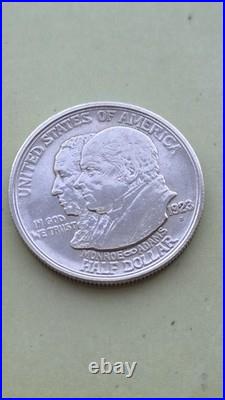
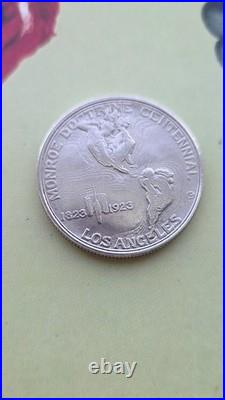
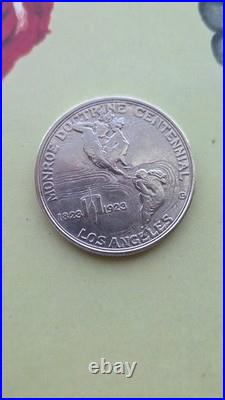
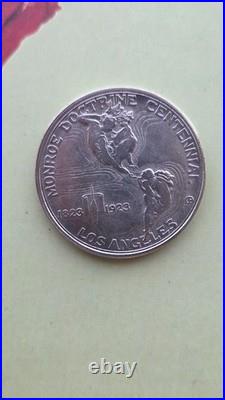
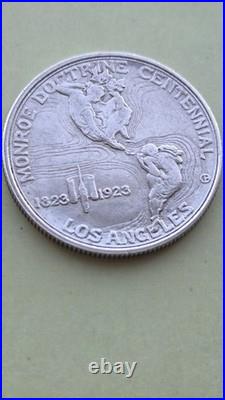
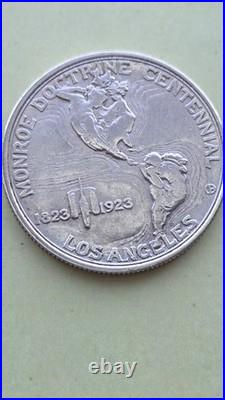
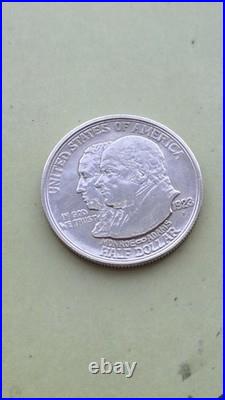
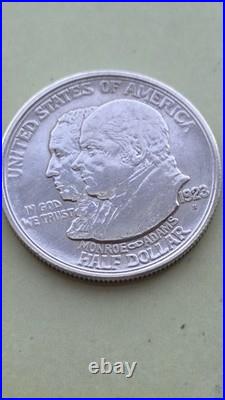
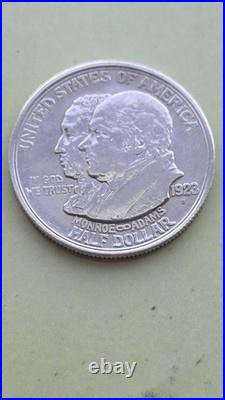
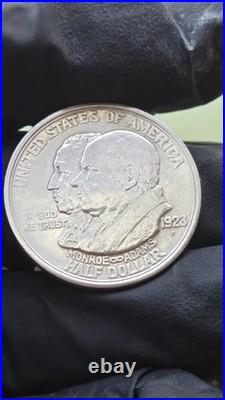
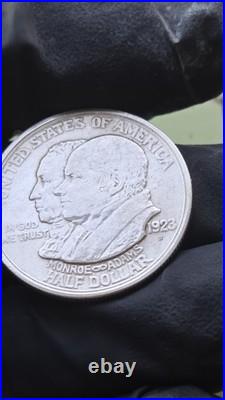
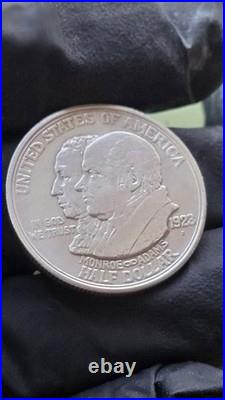
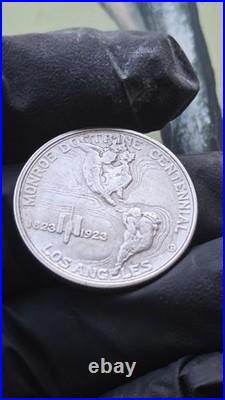
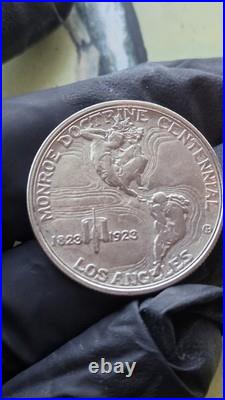
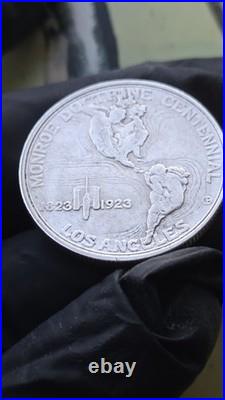
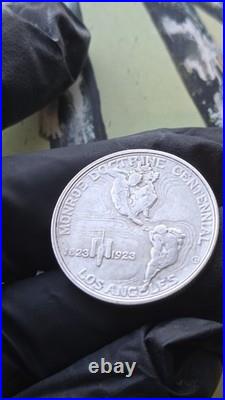
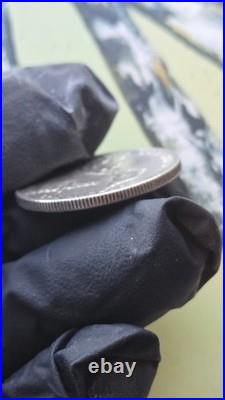
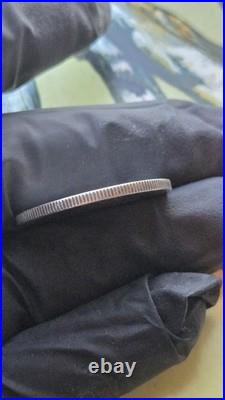
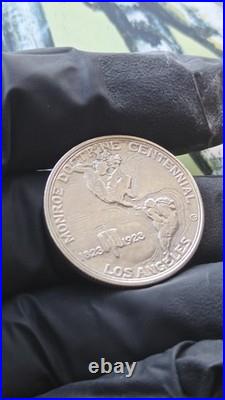

1923-S Monroe Doctrine Centennial Half Dollar – Uncirculated, Clean & Shiny – From Original Book – San Francisco Mint. Genuine 1923-S Monroe Doctrine Centennial half dollar that came out of an original book. Silver commemorative struck only at the San Francisco Mint. Issued for the 100th anniversary of the Monroe Doctrine and tied to the 1923 Los Angeles American Historical Revue and Motion Picture Industry Exposition. This is an uncirculated example – very clean and shiny, with strong original detail and surfaces preserved from being stored in a book rather than circulated. Mint: San Francisco (S mint mark below the date on the obverse). Composition: 90% silver, 10% copper. Weight: 12.50 grams. Silver content: 0.3617 troy oz actual silver weight. Diameter: 30.6 mm. Mintage: 274,077 (Congress authorized a maximum of 300,000). Obverse: Conjoined left-facing portraits of President James Monroe (left) and Secretary of State John Quincy Adams (right). Their names appear below, joined by two chain links representing their joint role in the Monroe Doctrine. Inscriptions: UNITED STATES OF AMERICA along the top, IN GOD WE TRUST at left, HALF DOLLAR at bottom, date 1923 and S mint mark at right. Reverse: Stylized female figures whose outlines form the continents of North and South America. North America holds an olive branch of peace and reaches toward South America, who carries a cornucopia (horn of plenty). Their hands meet at the Panama Canal. Between the dates 1823 and 1923 sit a scroll and quill representing the doctrine itself. Inscriptions: MONROE DOCTRINE CENTENNIAL around the top and LOS ANGELES at the bottom. Chester Beach’s monogram appears at the right. Congress authorized the coin on January 24, 1923 (Public Law 67-391). The exposition and the coin were part of a public-relations effort by the film industry. The biggest was the case of silent-film star Roscoe “Fatty” Arbuckle, who was charged with manslaughter after actress Virginia Rappe died following a party at a San Francisco hotel. Arbuckle was ultimately acquitted after three trials, but his career was ruined. Around the same time, director William Desmond Taylor was murdered in Los Angeles (the case remains unsolved), and actor Wallace Reid died from complications of drug addiction. These stories led to calls for censorship and boycotts. Studios responded by creating the Hays Office for self-regulation and by staging the 1923 Los Angeles exposition to generate positive publicity. To get Congress to approve a commemorative coin as a fundraiser, organizers linked the event to the 100th anniversary of the Monroe Doctrine. Sales of the coins were disappointing. By late 1923 the remaining coins were released into circulation at face value. That is why most survivors show circulation wear. High-grade uncirculated examples are scarce!! The reverse design drew controversy. It closely resembles a 1899 medal by Raphael Beck used for the 1901 Pan-American Exposition. Beach and Commission of Fine Arts member James Earle Fraser denied any copying, but the similarity is widely noted. This example came out of an original book and is uncirculated – very clean and shiny. Photos show the exact coin. Check out my shop yall for my history.


